Women's Workouts
What Is a Good Full-Body Workout at Home for Beginner Women?
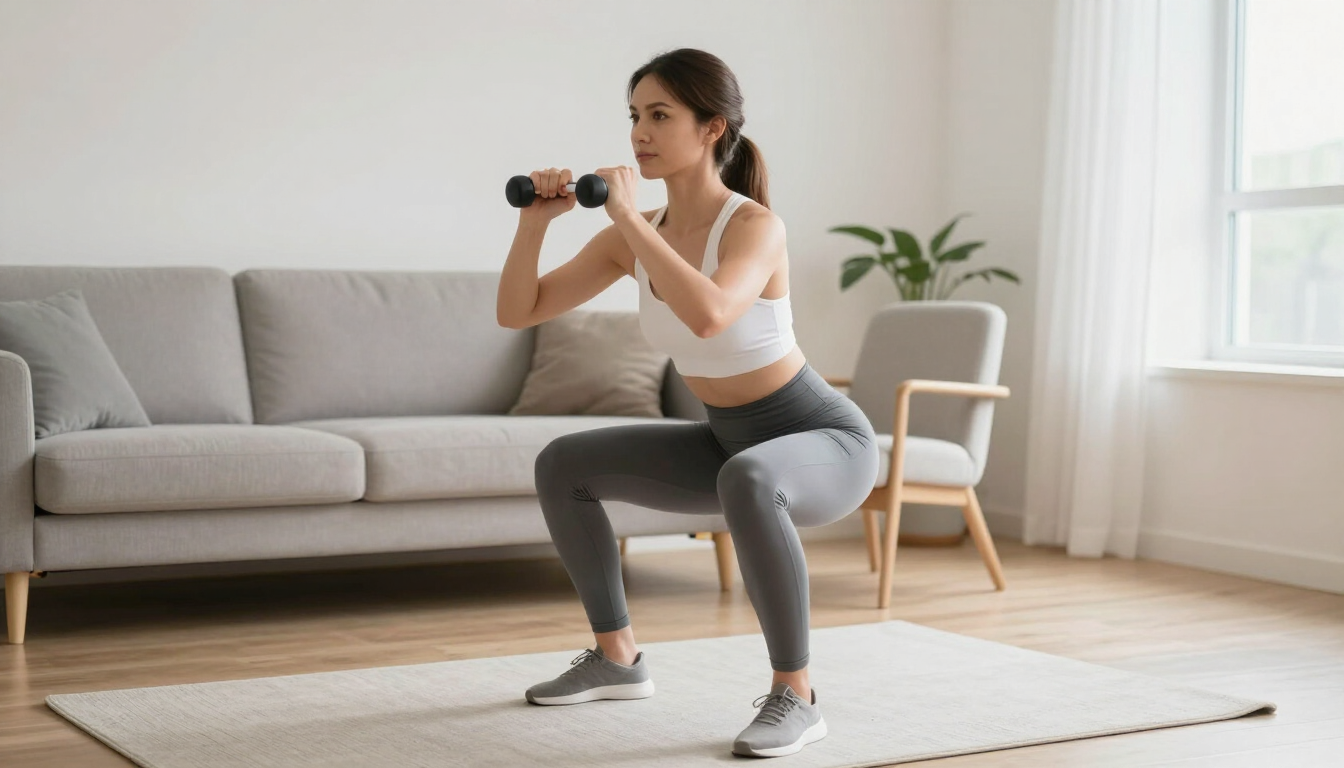
A good full-body home workout should do more than make you sweat. It should give the major movement patterns a job: your knees and hips should bend and extend, your upper body should push and pull, your trunk should resist unwanted movement, and your heart rate should rise enough to build general fitness.
You can do that without a gym. Bodyweight, a sturdy chair or countertop, and a backpack are enough to create a surprisingly complete beginner session.
The short answer
For most beginners, a simple full-body routine performed two or three times per week is more useful than a complicated daily split. Start with controlled exercises, leave a few good repetitions in reserve, and progress gradually.
Among U.S. women age 18-44 surveyed in 2022 and 2024, only about one quarter reported leisure-time activity meeting both aerobic and muscle-strengthening recommendations.
The gap between knowing exercise is useful and actually doing it is large. CDC analysis of 2022 and 2024 National Health Interview Survey data found that 25.1% of U.S. women age 18-44 reported leisure-time activity meeting both aerobic and muscle-strengthening recommendations, while 47.2% met neither. More than half - 55.3% - reported no leisure-time muscle-strengthening activity. A realistic home plan matters because convenience can remove one of the biggest practical barriers: getting to the gym.
What makes a workout “full-body”?
| Movement job | What it trains | Home example |
|---|---|---|
| Squat | Quads, glutes, trunk | Chair squat or bodyweight squat |
| Hinge | Glutes, hamstrings, back control | Hip hinge / good morning |
| Push | Chest, shoulders, triceps | Incline push-up |
| Pull | Upper back, lats, biceps | Backpack row |
| Brace | Abdominals and trunk control | Bird dog or dead bug |
| Condition | Heart rate, coordination | March in place / step jack |
You do not have to perform every possible movement in every session. But if your “full-body workout” is ten variations of squats and ab exercises, it is not actually distributing work across the body very well.
Want the complete structured program? This sample workout teaches the system — the complete guide tells you exactly how the sessions change across four weeks. View the 28-Day At-Home Workout →
Your 20-minute beginner full-body workout
Start with one round if you have been inactive for a long time. Build toward two rounds. Rest 30-75 seconds between exercises as needed and 1-2 minutes between rounds. A beginner workout does not become better because you refuse to rest.
| Exercise | Dose | Technique target |
|---|---|---|
| Warm-up: march in place | 60-90 sec | Tall posture, quiet foot contacts |
| Chair or bodyweight squat | 8-12 reps | Whole foot stays planted |
| Glute bridge | 10-12 reps | Finish with glutes, not a back arch |
| Hip hinge / good morning | 8-12 reps | Send hips back; keep a long spine |
| Incline push-up | 6-12 reps | Body moves as one line |
| Backpack bent-over row | 8-12 reps | Pull elbows toward lower ribs |
| Bird dog | 6 per side | Reach long without rotating the hips |
| Optional fast march | 45-60 sec | Raise breathing without losing control |
Squat: choose a depth you can control while keeping the feet grounded and knees tracking with the toes.
Squat: your knee-dominant pattern
Stand with a comfortable stance. Sit down and slightly back, allowing the knees to bend in the same general direction as the toes. Stop before your heels lift or your knees collapse inward. If balance or depth is difficult, use a chair as a target.
Common mistake: turning the movement into a forward fold. Let the torso lean naturally, but keep the chest and pelvis moving together rather than collapsing at the waist.
Hip hinge: the hips travel back more than the knees travel forward.
Hip hinge: train the back of the body
Keep the knees soft and push the hips backward as if closing a car door with your hips. The torso inclines as the hips travel back. Stop where you can maintain a long spine and feel tension in the hamstrings and glutes.
Common mistake: squatting instead of hinging. If your knees keep moving forward, place your hips a few inches in front of a wall and practice reaching the wall with your hips.
Incline push-up: changing the height of the surface makes the exercise easier or harder without changing the basic pattern.
Incline push-up: scalable upper-body pushing
Place the hands on a stable countertop, bench or sturdy table. Walk the feet back until the body forms one line. Bend the elbows slightly back from the torso, bring the chest toward the surface, then press away. A higher surface is easier; a lower surface is harder.
Backpack row: do not forget pulling
A home program often becomes push-heavy because push-ups are obvious and pulling exercises are not. A backpack row solves that problem. Load a backpack lightly, hinge forward, brace the trunk and pull the bag toward the lower ribs. If the low back fatigues before the upper back, use less load or support one hand on a chair.
Bird dog: core training without endless crunches
From hands and knees, reach one arm and the opposite leg away from the body. The point is not how high you lift; it is whether the pelvis and ribs can stay controlled while the limbs move. If your trunk twists, shorten the range.
Want the complete structured program?
This sample workout teaches the system. The complete guide tells you exactly how the sessions change across four weeks.
View the 28-Day At-Home WorkoutHow hard should the workout feel?
Use a simple 1-10 effort scale. Most work in a beginner strength session can sit around RPE 5-7: clearly challenging, but not an all-out effort. At the end of a set, you should often feel as if you could perform roughly two or three more clean repetitions. This is a practical way to avoid starting too heavy while still creating a useful stimulus.
You do not need to train to failure
The 2026 ACSM resistance-training position stand emphasizes that a wide range of resistance-training approaches can improve outcomes and that momentary muscular failure is not required for the average healthy adult. Consistency, progressive overload and training the major muscle groups matter more than making every set maximal.
How to progress at home without buying a full gym
- Add repetitions until you reach the top of the written range with clean form.
- Slow the lowering phase - for example, three seconds down on squats or push-ups.
- Increase range of motion when it is comfortable and controlled.
- Use a harder leverage position, such as a lower push-up surface.
- Add a small amount of external resistance with a backpack, water bottles or dumbbells.
- Add a set only when the current workload is well tolerated.
Only change one variable at a time. If you simultaneously double the repetitions, add a heavy backpack and reduce all rest periods, you will not know which change caused your technique or recovery to fall apart.
How many days per week?
A beginner can make meaningful progress with two or three full-body strength sessions per week. The U.S. Physical Activity Guidelines recommend muscle-strengthening activity involving all major muscle groups on at least two days each week, alongside 150-300 minutes of moderate-intensity aerobic activity or the vigorous-intensity equivalent. Your 20-minute home sessions are a foundation, not the entire weekly movement target.
Walking is an easy companion. If you perform two or three home workouts and accumulate regular brisk walking across the week, you have a much more complete plan than a workout challenge that ignores aerobic activity entirely.
Frequently asked questions
Frequently Asked Questions
Prefer low-impact mat training? Try our beginner 15-minute Pilates routine.
Ready to transition into a gym? Read First Time at the Gym for Beginner Women for a complete first-visit plan.
Get the Complete 28-Day At-Home Workout
Ready to turn one workout into a complete 28-day plan? The complete program includes 28 scheduled days, progressive weekly programming, a full exercise library, easier and harder variations, recovery days, logs, assessments and printable trackers.
Get the Complete 28-Day At-Home WorkoutReferences
- CDC. Leisure-Time Physical Activity Among Women of Reproductive Age - United States, 2022 and 2024. MMWR 2025; corrected 2026. https://www.cdc.gov/mmwr/volumes/74/wr/mm7441a2.htm
- U.S. Department of Health and Human Services. Physical Activity Guidelines for Americans, 2nd edition. https://odphp.health.gov/our-work/nutrition-physical-activity/physical-activity-guidelines/current-guidelines/top-10-things-know
- American College of Sports Medicine. 2026 resistance training position stand / guidance. https://acsm.org/resistance-training-guidelines-update-2026/
- Hagstrom AD, et al. The Effect of Resistance Training in Women on Dynamic Strength and Muscular Hypertrophy. PMID: 31820374. https://pubmed.ncbi.nlm.nih.gov/31820374/