Women's Workouts
First Time at the Gym? Exactly What Beginner Women Should Do
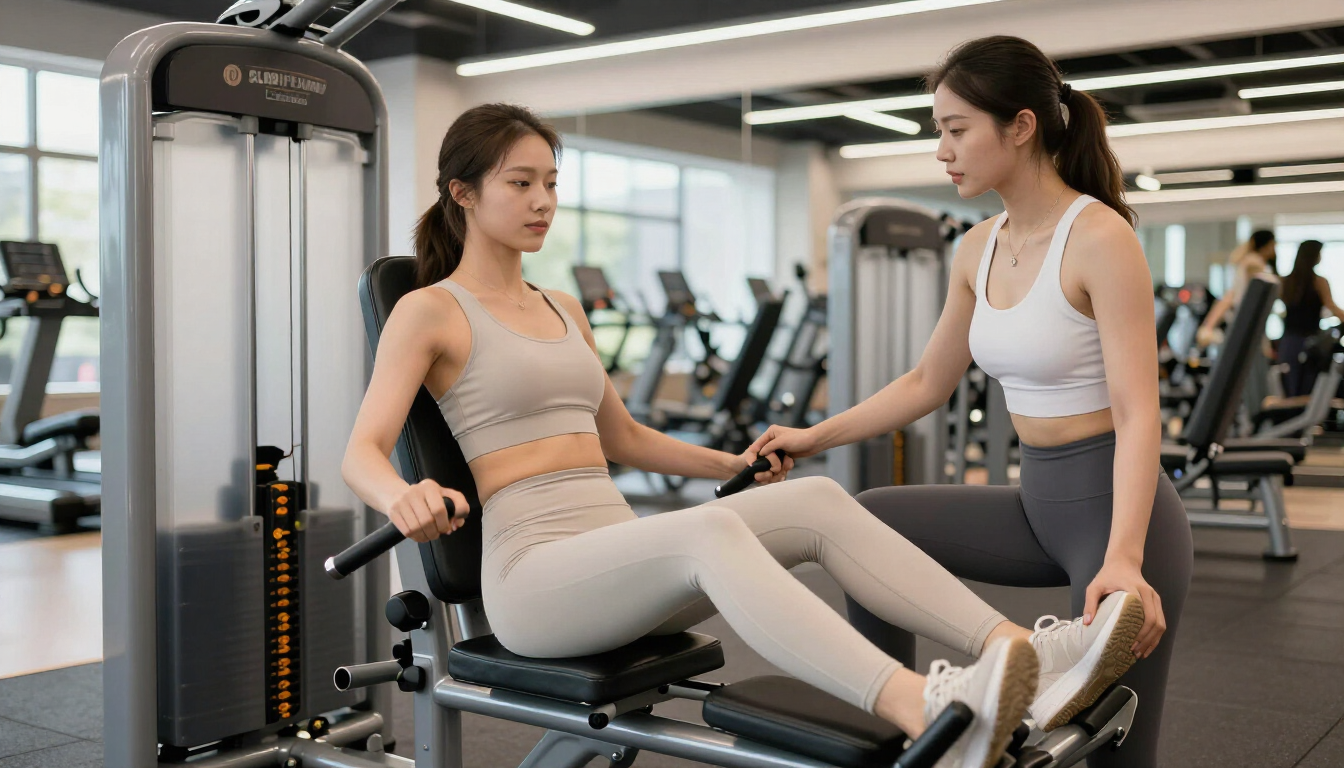
You joined a gym. Now you are standing inside wondering which machine to use, how much weight to choose, whether you are resting too long, and whether everyone else somehow received a rulebook you missed.
They did not. Most gym confidence comes from familiarity, not personality. The fastest way to feel less lost is to reduce the number of decisions. Your first visit needs a short route, a handful of machines and a simple rule for choosing the load.
Your only job on Day 1
Learn where the equipment is, complete a few clean sets, write down what you used, and leave with enough energy to come back. Your first workout is not an exam.
Before you go: bring less than you think
- Comfortable training clothes you can move in.
- Supportive shoes appropriate for the activity you plan to do.
- Water bottle.
- Phone or small notebook for logging exercises, weights and reps.
- Optional towel and lock depending on the gym.
- A simple workout saved before you arrive - not 20 screenshots from social media.
Avoid carrying around supplements, lifting straps, belts or other accessories you do not yet need. Equipment should solve a real training problem, not make you feel as if you have to look experienced.
Do a two-minute orientation lap
Before you train, walk around once and locate five things: the cardio area, selectorized machines, cable station, dumbbell area and stretching/open floor space. If a machine looks confusing, ask a staff member how the seat and pads adjust. That is normal gym behavior, not an admission of failure.
Basic gym etiquette that prevents most awkward moments
- Wipe down benches and pads after use if your gym provides cleaning supplies.
- Do not sit on a machine scrolling for several minutes between sets when people are waiting.
- Return dumbbells and plates to the proper rack.
- If someone is using equipment you need, ask “How many sets do you have left?” rather than hovering.
- Do not walk directly in front of someone performing a heavy set when you can safely go around.
- Use headphones at a reasonable volume so you can still notice your surroundings.
How do you choose your first weight?
Ignore the person next to you. Your first load should let you learn the movement. Start lighter than you think, perform 8-10 controlled repetitions, and ask how many good repetitions you could still complete.
| How the set feels | Approx. reps left | What to do |
|---|---|---|
| Very easy | 5+ | Add a small amount of weight next set. |
| Comfortably challenging | 2-4 | Good beginner working range. |
| Very hard / form changing | 0-1 | Reduce the load or stop the set earlier. |
Most of your first month does not need to be at maximum effort. The updated 2026 ACSM resistance-training guidance emphasizes that training to momentary muscular failure is not required for the average healthy adult. For a beginner, clean repetitions and repeatability are more valuable than grinding through one ugly final rep.
Your first workout is solved. What about the next 30 days? The complete beginner gym guide organizes every visit with progressive workouts and a full exercise library. View the Complete Beginner Gym Guide →
Your exact first gym workout
Use this as a simple full-body route. Perform one lighter practice set on the first machine if you need it. Then complete the written working sets. Rest about 60-120 seconds between sets, longer if your breathing or technique has not recovered.
| Exercise | Dose | Main job | Key cue |
|---|---|---|---|
| 5-min treadmill or bike | Easy-moderate | Warm up | You should be able to speak normally. |
| Leg press | 2 x 8-12 | Quads + glutes | Stop before the pelvis rolls off the pad. |
| Chest press machine | 2 x 8-12 | Chest + triceps | Keep shoulders down and back supported. |
| Lat pulldown | 2 x 8-12 | Lats + upper back | Pull toward upper chest; do not yank behind the neck. |
| Seated cable row | 2 x 8-12 | Upper back + biceps | Pull to lower ribs without rocking the torso. |
| Leg curl | 2 x 10-12 | Hamstrings | Control both the curl and the return. |
| Pallof press or dead bug | 2 sets | Core | Keep ribs and pelvis quiet. |
| Optional easy cooldown | 3-5 min | Recovery | Bring breathing down gradually. |
Leg press: adjust the seat so you can reach a comfortable knee bend without the pelvis rolling away from the back pad.
Leg press: setup matters more than the number on the stack
Sit with the back and pelvis supported. Place the feet around hip-to-shoulder width on the platform. Unlock the machine according to its design, lower under control, and stop before your pelvis starts to curl away from the pad. Press through the whole foot. Do not slam the knees into a hard lockout.
First-weight rule: choose a load that lets you complete at least eight smooth repetitions with several repetitions still available.
Lat pulldown: keep the torso mostly tall and drive the elbows down rather than turning the movement into a swinging row.
Lat pulldown: pull to the front, not behind the neck
Adjust the thigh pad so the legs are secure. Take a grip a little wider than shoulder width. Start with the arms long and shoulders controlled, then drive the elbows down and bring the bar toward the upper chest. Return slowly until the arms are long again. Behind-the-neck pulldowns are unnecessary for a beginner.
Seated cable row: finish by bringing the handle toward the lower ribs without throwing the chest backward.
Seated cable row: make the back do the work
Sit tall, brace the feet, and begin with the arms long without collapsing forward. Pull the handle toward the lower ribs while the shoulder blades move naturally. Stop when the elbows are beside the body; you do not need to pull them far behind you. Return under control.
Leg curl: set the machine so the knee aligns reasonably with the machine pivot and the pad sits comfortably above the ankle.
Leg curl: a simple hamstring machine
Adjust the seat and pad so the knee joint lines up approximately with the machine pivot. Curl the pad by bending the knees, pause briefly, then return slowly. If the hips lift or you need momentum, reduce the weight.
Your first workout is solved. What about the next 30 days?
Knowing what to do once is helpful. Knowing what to do every time you walk into the gym is what creates confidence.
View the Complete Beginner Gym GuideHow long should the first workout take?
Usually 35-55 minutes is plenty for this session once you include setup and rest. If the gym is crowded or you are still learning machine adjustments, it may take longer. Do not turn speed into a goal. Your first priority is learning the route and recording the settings that worked.
What to write in your training log
- Exercise name.
- Seat or pad setting if the machine uses numbered adjustments.
- Weight used.
- Repetitions completed in each set.
- Approximate effort (RPE) or how many repetitions you felt you had left.
- One short note if something felt unusually uncomfortable or technically difficult.
This removes guesswork from the next visit. If you used 40 lb for 10 and 10 repetitions on the chest press at a comfortable effort, you do not have to rediscover that starting point.
A simple progression rule for Month 1
Double progression
- Keep the same weight until you can reach the top of the repetition range on every set with clean technique. Then increase the load by the smallest practical amount and return to the lower end of the range.
- Example: if the target is 8-12 reps and you perform 10, 9 this week, stay with the weight. When you can perform 12, 12 with good form and appropriate effort, add a small amount of weight next time and aim for 8-10 again.
What the data says about the opportunity
CDC data underline why a beginner gym guide can solve a real problem. Among U.S. women age 18-44 in the 2022 and 2024 NHIS data, 55.3% reported no leisure-time muscle-strengthening activity and only 25.1% reported meeting both aerobic and strengthening recommendations. A low-friction first month can help turn an intimidating environment into a repeatable habit.
Frequently asked questions
Frequently Asked Questions
Not ready for the gym yet? Start with our beginner full-body home workout — no equipment required.
Get the Complete Beginner Gym Guide
Stop guessing what to do next. The full 30-day guide includes progressive workouts, machine setup instructions, the complete illustrated exercise library, RPE/RIR guidance, substitutions, cardio integration, workout logs, progress assessments and recovery basics.
Get the Complete Beginner Gym GuideReferences
- CDC. Leisure-Time Physical Activity Among Women of Reproductive Age - United States, 2022 and 2024. MMWR 2025; corrected 2026. https://www.cdc.gov/mmwr/volumes/74/wr/mm7441a2.htm
- American College of Sports Medicine. 2026 resistance training position stand / guidance. https://acsm.org/resistance-training-guidelines-update-2026/
- U.S. Department of Health and Human Services. Physical Activity Guidelines for Americans, 2nd edition. https://odphp.health.gov/our-work/nutrition-physical-activity/physical-activity-guidelines/current-guidelines/top-10-things-know