Macros and Nutrition
How Much Protein Do You Need Per Day? A Goal-Based Guide for Health, Fat Loss and Muscle Gain
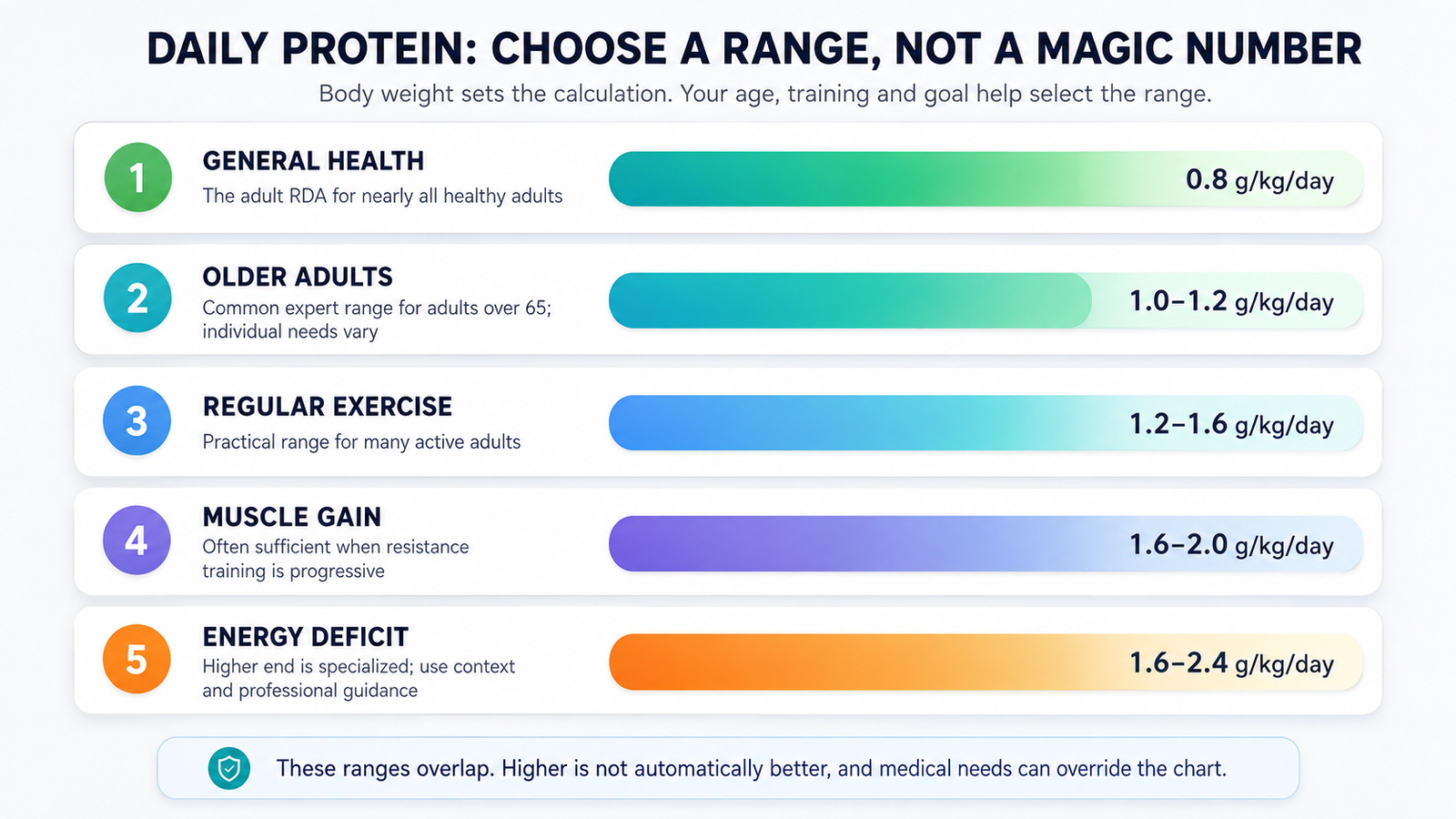
Protein is the only macronutrient with a widely recognised minimum requirement, yet the number most people have heard — 0.8 grams per kilogram of body weight per day — describes a floor, not a target. For anyone who exercises, wants to preserve muscle while losing fat, or is over 65, the evidence points to substantially higher intakes.
This guide explains what the research says, how to calculate a number for your own goal, and how to distribute that protein across meals without overthinking it.
Quick Calculation
Multiply your body weight in kilograms by the range that matches your goal from the table below. If you use pounds, divide your weight by 2.2 first.
| Goal | Daily protein range | Practical starting point |
|---|---|---|
| General health (sedentary adult) | 0.8–1.2 g/kg | 1.0 g/kg |
| Adults over 65 | 1.2–1.6 g/kg | 1.4 g/kg |
| Regular exercise (recreational) | 1.4–1.7 g/kg | 1.6 g/kg |
| Muscle gain (resistance training) | 1.6–2.2 g/kg | 1.8 g/kg |
| Fat loss (calorie deficit) | 1.8–2.4 g/kg | 2.0 g/kg |
| Endurance training | 1.2–1.6 g/kg | 1.4 g/kg |
Use the VELOFITZONE Macro Calculator to get a full macronutrient breakdown built around your protein target.
Why Protein Needs Differ From Person to Person
The amount of protein your body needs each day depends on several interacting factors: how much muscle mass you carry, how hard you train, whether you are in a calorie deficit, your age, and the overall quality of your diet. Two people of the same weight can have genuinely different requirements because their training load, lean body mass, and goals are different.
Population-level studies estimate average requirements, and those averages are useful starting points. They are not, however, individual measurements. Treat the ranges in this guide as reasoned starting points, apply them for four to six weeks, and adjust based on how your body responds.
What Does 0.8 g/kg Mean?
The 0.8 g/kg figure is the Recommended Dietary Allowance (RDA) published by the United States Institute of Medicine. An RDA is defined as the amount sufficient to meet the needs of 97.5 percent of healthy, sedentary adults. It is a minimum floor, not an optimal target.
Multiple systematic reviews and meta-analyses published since 2010 have found that intakes above 1.6 g/kg produce greater lean mass retention and improvements in body composition in people who train, and that older adults require higher intakes than the RDA to offset age-related muscle loss.
Important Language Note
Grams per kilogram (g/kg) refers to grams of protein per kilogram of total body weight unless otherwise stated. Some sports nutrition literature uses lean body mass (LBM) instead. If a source specifies LBM, the numbers will be higher but mathematically equivalent for most body-fat levels. This guide uses total body weight throughout for simplicity.
Protein Ranges by Goal
The ranges below are derived from systematic reviews and position statements from major sports nutrition bodies, including the International Society of Sports Nutrition (ISSN), the American College of Sports Medicine (ACSM), and the European Society of Clinical Nutrition and Metabolism (ESPEN).
| Goal | Range (g/kg/day) | Key evidence source |
|---|---|---|
| Sedentary health maintenance | 0.8–1.2 | Institute of Medicine DRI (2005) |
| Adults over 65 (PROT-AGE) | 1.2–1.6 | Bauer et al., JAMDA 2013 |
| Recreational exercise | 1.4–1.7 | Thomas et al., ACSM 2016 |
| Muscle gain / hypertrophy | 1.6–2.2 | Morton et al., BJSM 2018 |
| Fat loss (energy restriction) | 1.8–2.4 | Helms et al., IJSNEM 2014 |
| Endurance sport | 1.2–1.6 | Thomas et al., ACSM 2016 |
The VELOFITZONE Four-Step Protein Method
- Record your body weight in kilograms (or convert from pounds by dividing by 2.2).
- Choose the range that matches your primary goal from the table above.
- Pick the midpoint of that range as your daily starting target.
- Divide that total across three to five meals, aiming for at least 25–40 g per meal.
Worked example — 70 kg person aiming for muscle gain
- Body weight: 70 kg
- Goal: muscle gain — range 1.6–2.2 g/kg
- Midpoint: 1.9 g/kg
- Daily target: 70 × 1.9 = 133 g protein
- Across 4 meals: ~33 g per meal
How to Calculate Protein From Body Weight
If you prefer to work in pounds, divide your weight in pounds by 2.2 to get kilograms, then multiply by your target range.
| Weight (lb) | Weight (kg) | Sedentary (1.0 g/kg) | Exercise (1.6 g/kg) | Muscle gain (1.9 g/kg) | Fat loss (2.0 g/kg) |
|---|---|---|---|---|---|
| 110 lb | 50 kg | 50 g | 80 g | 95 g | 100 g |
| 132 lb | 60 kg | 60 g | 96 g | 114 g | 120 g |
| 154 lb | 70 kg | 70 g | 112 g | 133 g | 140 g |
| 176 lb | 80 kg | 80 g | 128 g | 152 g | 160 g |
| 198 lb | 90 kg | 90 g | 144 g | 171 g | 180 g |
| 220 lb | 100 kg | 100 g | 160 g | 190 g | 200 g |
Protein for General Health
For adults who do not exercise regularly, the evidence supports intakes of 0.8–1.2 g/kg per day. At the lower end this meets the RDA; at the upper end it provides a modest buffer for satiety and tissue maintenance without adding meaningless calories.
Most adults in Western countries already consume around 1.0–1.2 g/kg per day through normal food choices, so deliberate tracking is usually unnecessary for this group.
Protein for Regular Exercise
Both the ACSM and the Academy of Nutrition and Dietetics recommend 1.4–1.7 g/kg for adults engaged in regular resistance or aerobic exercise. The higher end of this range applies when training volume is high or when the person is in a slight calorie deficit.
A 70 kg recreational exerciser needs roughly 98–119 g of protein per day at this range — achievable with three protein-containing meals and one snack without supplements.
How Much Protein for Muscle Gain?
A 2018 systematic review and meta-analysis by Morton and colleagues, published in the British Journal of Sports Medicine, analysed 49 randomised controlled trials and found that protein intakes above 1.62 g/kg per day produced no additional lean mass gain. The practical upper boundary for hypertrophy is therefore around 1.6–2.2 g/kg, with the higher end providing a useful margin during periods of higher training intensity or imperfect food quality.
Worked example — 80 kg lifter
- Body weight: 80 kg
- Goal: muscle gain — target 1.8 g/kg
- Daily protein: 80 × 1.8 = 144 g
- Across 4 meals: ~36 g per meal
Total calorie intake and sleep quality are the limiting factors for muscle gain in most recreational lifters. Hitting 1.6–2.0 g/kg is sufficient; chasing 2.5 g/kg or more adds calories without evidence of benefit.
How Much Protein for Fat Loss?
During a calorie deficit, higher protein intakes serve three functions: they preserve lean muscle mass, they increase satiety (making adherence easier), and they have a slightly higher thermic effect than carbohydrate or fat, meaning the body expends slightly more energy digesting them.
A 2014 review by Helms and colleagues recommended 2.3–3.1 g/kg of lean body mass for natural bodybuilders in a deficit. For practical use with total body weight, a target of 1.8–2.4 g/kg is well-supported and conservative.
Worked example — fat loss
- Body weight: 75 kg
- Goal: fat loss in a 400-calorie deficit
- Protein target: 2.0 g/kg
- Daily protein: 75 × 2.0 = 150 g
- Remaining calories split between carbohydrate and fat
Protein for Adults Over 65
Muscle protein synthesis becomes less efficient with age — a phenomenon called anabolic resistance. Older adults need both more total protein per day and larger per-meal doses to achieve the same muscle-protein synthesis response as younger adults.
The PROT-AGE Study Group (Bauer et al., 2013) recommends 1.2–1.6 g/kg per day for healthy older adults, rising to 1.5–2.0 g/kg when illness, injury, or rehabilitation is present. Individual meals should contain at least 25–30 g of protein to cross the threshold for maximal muscle-protein synthesis.
Protein for Endurance Training
Endurance athletes use protein for muscle repair, enzyme synthesis, and as a small fuel source (around 5–10 percent of energy during prolonged exercise). The ACSM recommends 1.2–1.6 g/kg, at the lower end for moderate-volume training and the upper end for high-volume periods.
How Much Protein Per Meal?
Spreading protein across meals is more effective than concentrating it in one or two large servings. Research by Areta and colleagues found that consuming 20 g of whey protein every three hours stimulated greater muscle-protein synthesis over 12 hours than either 40 g every six hours or 10 g every 90 minutes.
For practical planning, aim for 25–40 g of protein at each of three to five meals, depending on your total daily target.
| Daily target | Meals per day | Protein per meal |
|---|---|---|
| 100 g | 3 | ~33 g |
| 120 g | 4 | ~30 g |
| 150 g | 4 | ~38 g |
| 160 g | 5 | ~32 g |
| 180 g | 5 | ~36 g |
No 30-Gram Absorption Limit
The idea that the body can only absorb 30 g of protein per meal is a myth. The digestive system can absorb arbitrarily large amounts of amino acids; what changes is the rate of absorption and the subsequent rate of muscle-protein synthesis. A large protein meal is not wasted — it is simply used for other metabolic functions (gluconeogenesis, oxidation) rather than muscle building. Spreading protein across meals optimises the muscle-protein synthesis signal, but it does not prevent absorption.
Does Protein Timing Matter?
Protein timing — specifically consuming protein close to a resistance training session — has a modest positive effect on muscle-protein synthesis. A 2013 meta-analysis by Schoenfeld and Aragon found a statistically significant but practically small benefit when protein was consumed within one hour of training.
The practical recommendation: eat a protein-containing meal one to two hours before training and another within two hours after. If total daily protein intake is adequate, precise timing matters less than consistency.
Best Protein Foods: Think Beyond the Protein Number
Food quality affects how well protein is used. Complete proteins — those containing all nine essential amino acids in adequate proportions — are found in most animal-based foods and a handful of plant foods (soy, quinoa, buckwheat).
| Food | Protein per 100 g | Notes |
|---|---|---|
| Chicken breast (cooked) | 31 g | Complete, low fat |
| Tuna (canned in water) | 26 g | Complete, convenient |
| Eggs | 13 g | Complete, high bioavailability |
| Greek yoghurt (plain, low-fat) | 10 g | Complete, good calcium source |
| Cottage cheese | 11 g | Slow-digesting casein |
| Tempeh | 19 g | Complete, fermented soy |
| Lentils (cooked) | 9 g | Incomplete — pair with rice or seeds |
| Edamame | 11 g | Complete soy-based protein |
| Tofu (firm) | 8 g | Complete when variety is adequate |
| Whey protein powder | ~80 g | Convenient, high BCAA content |
Can a Plant-Based Diet Provide Enough Protein?
Yes. A well-planned plant-based diet can meet protein targets at any goal level, including muscle gain. The key practical steps are: eat a variety of plant proteins across the day (legumes, grains, nuts, seeds, soy products), prioritise higher-protein plant foods, and consider a higher total daily target (add 10–15 percent) to offset slightly lower digestibility scores compared with animal proteins.
Digestibility is measured by the Digestible Indispensable Amino Acid Score (DIAAS). Most plant proteins score lower than animal proteins on this scale, which is why total intake slightly above the calculated target is recommended for plant-based athletes.
Do You Need Protein Powder?
Protein powder is a convenient tool, not a requirement. If whole food sources in your day already cover your target, powder adds nothing. It becomes useful when: total targets are high (above 160–180 g per day), appetite is low during a deficit, post-training convenience matters, or whole food options are limited.
Whey concentrate, whey isolate, and soy protein isolate are the most studied options. Casein is slower-digesting and may be preferable at night. Pea and rice protein blended together provide a complete amino acid profile for plant-based choices.
Should Protein Be Calculated as a Percentage of Calories?
Percentage-based targets (e.g. "30 percent of calories from protein") are less precise than g/kg targets because they depend on total calorie intake. At a low calorie intake, 30 percent may still fall below 100 g per day; at a very high intake, it may push well above 200 g unnecessarily.
The g/kg approach is more reliable because it anchors protein to the tissue it protects (muscle mass) rather than to total energy intake. Use g/kg as your primary target and check that the resulting percentage is broadly reasonable (typically 20–35 percent of total calories).
Best Practice
Calculate your g/kg target first. Then verify the resulting percentage of calories falls between 20 and 35 percent. If it does, proceed. If it exceeds 35 percent, check whether your total calorie intake is adequate rather than automatically reducing protein.
Seven Common Protein-Planning Mistakes
- Using 0.8 g/kg as a target rather than a floor.
- Consuming most daily protein in a single evening meal.
- Counting all nitrogen-containing compounds as complete protein (e.g. gelatin, collagen).
- Ignoring protein quality on a plant-based diet.
- Relying on percentage targets alone when calorie intake is very low.
- Assuming more protein is always better beyond evidence-based upper limits.
- Neglecting total calories — protein cannot preserve muscle in a severe deficit without adequate overall energy.
When to Ask a Healthcare Professional or Dietitian
The ranges in this guide are appropriate for healthy adults. Seek professional guidance if you have a history of kidney disease (high protein intakes are not appropriate without medical supervision), liver disease, phenylketonuria, are pregnant or breastfeeding, or are managing a medical condition that affects nutrient metabolism.
Frequently Asked Questions
Try the VELOFITZONE Calculators
Use the Macro Calculator to get a complete daily breakdown of protein, carbohydrate, and fat targets based on your body weight, goal, and calorie intake. The All-in-One Fitness Calculator covers BMR, TDEE, calorie goal, and macros in a single four-step flow.
Macro Calculator — full protein, carb, and fat breakdown for your goal
All-in-One Fitness Calculator — BMR, TDEE, calorie goal, and macros in one flow
Calorie Calculator — set your daily calorie target before adjusting macros
BMR vs TDEE Guide — understand the energy numbers behind your protein target
How Many Calories Should I Eat Per Day? — set your calorie context before dialling in protein
References
- Institute of Medicine. Dietary Reference Intakes for Energy, Carbohydrate, Fiber, Fat, Fatty Acids, Cholesterol, Protein, and Amino Acids. Washington DC: National Academies Press; 2005.
- Morton RW, Murphy KT, McKellar SR, et al. A systematic review, meta-analysis and meta-regression of the effect of protein supplementation on resistance training-induced gains in muscle mass and strength in healthy adults. Br J Sports Med. 2018;52(6):376–384.
- Stokes T, Hector AJ, Morton RW, McGlory C, Phillips SM. Recent perspectives regarding the role of dietary protein for the promotion of muscle hypertrophy with resistance exercise training. Nutrients. 2018;10(2):180.
- Thomas DT, Erdman KA, Burke LM. American College of Sports Medicine joint position statement: nutrition and athletic performance. Med Sci Sports Exerc. 2016;48(3):543–568.
- Bauer J, Biolo G, Cederholm T, et al. Evidence-based recommendations for optimal dietary protein intake in older people: a position paper from the PROT-AGE Study Group. J Am Med Dir Assoc. 2013;14(8):542–559.
- Helms ER, Aragon AA, Fitschen PJ. Evidence-based recommendations for natural bodybuilding contest preparation: nutrition and supplementation. J Int Soc Sports Nutr. 2014;11:20.
- Areta JL, Burke LM, Ross ML, et al. Timing and distribution of protein ingestion during prolonged recovery from resistance exercise alters myofibrillar protein synthesis. J Physiol. 2013;591(9):2319–2331.
- Schoenfeld BJ, Aragon AA, Krieger JW. The effect of protein timing on muscle strength and hypertrophy: a meta-analysis. J Int Soc Sports Nutr. 2013;10:53.
- van Vliet S, Burd NA, van Loon LJ. The skeletal muscle anabolic response to plant- versus animal-based protein consumption. J Nutr. 2015;145(9):1981–1991.
- Berrazaga I, Micard V, Gueugneau M, Walrand S. The role of the anabolic properties of plant- versus animal-based protein sources in supporting muscle mass maintenance: a critical review. Nutrients. 2019;11(8):1825.
- Gorissen SHM, Crombag JJR, Senden JMG, et al. Protein content and amino acid composition of commercially available plant-based protein isolates. Amino Acids. 2018;50(12):1685–1695.
- Trommelen J, Betz MW, van Loon LJC. The muscle protein synthetic response to meal ingestion following resistance-type exercise. Sports Med. 2019;49(2):185–197.
- Phillips SM, Van Loon LJ. Dietary protein for athletes: from requirements to optimum adaptation. J Sports Sci. 2011;29(Suppl 1):S29–S38.
- Deutz NE, Bauer JM, Barazzoni R, et al. Protein intake and exercise for optimal muscle function with aging: recommendations from the ESPEN Expert Group. Clin Nutr. 2014;33(6):929–936.
- Cermak NM, Res PT, de Groot LC, Saris WH, van Loon LJ. Protein supplementation augments the adaptive response of skeletal muscle to resistance-type exercise training: a meta-analysis. Am J Clin Nutr. 2012;96(6):1454–1464.
- Witard OC, Jackman SR, Breen L, Smith K, Selby A, Tipton KD. Myofibrillar muscle protein synthesis rates subsequent to a meal in response to small and large bolus doses of dairy and soy protein. Am J Clin Nutr. 2014;99(1):86–95.