Calorie Deficit and Weight Loss
BMR vs TDEE: What’s the Difference, and Which Number Should You Use?
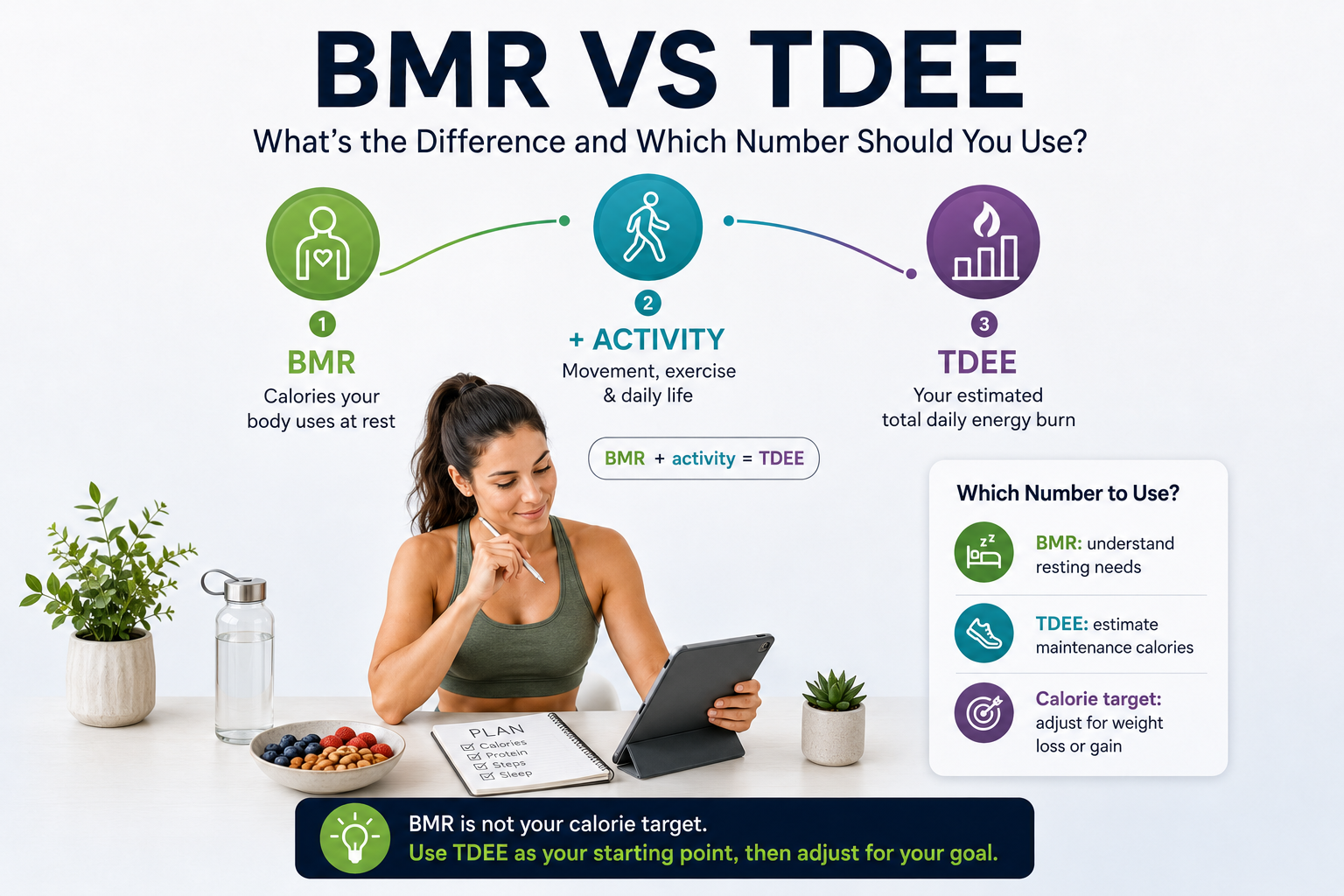
Two numbers come up constantly in fitness and nutrition: BMR and TDEE. Calculators display them alongside goal calorie targets, making it easy to treat all three as interchangeable. They are not. Understanding the difference determines whether you set the right calorie target or spend weeks eating too much, too little, or at the wrong anchor.
This guide explains what each number is, how it is estimated, and which one to use when you want to lose fat, gain muscle, or maintain your current weight.
What Is BMR?
BMR stands for basal metabolic rate. It is the amount of energy your body uses to stay alive at complete rest: no movement, no digestion, no thermal stress. In a clinical setting, measuring true BMR requires lying still in a controlled environment after an overnight fast. The number represents the minimum fuel cost of keeping your heart beating, lungs inflating, brain active, kidneys filtering, and every other involuntary process running.
BMR is expressed in kilocalories per day (kcal/day) and accounts for roughly 60–70 % of total daily energy expenditure in sedentary adults.
What BMR Pays For
| Body system | Approximate share of BMR |
|---|---|
| Brain and nervous system | ~20 % |
| Liver and gastrointestinal tract | ~25 % |
| Skeletal muscle (at rest) | ~18 % |
| Heart | ~9 % |
| Kidneys | ~7 % |
| All other organs and tissue | ~21 % |
These proportions vary with age, body composition, and health status. Organ mass is the single largest driver of BMR: people with more lean tissue burn more energy at rest than people with a higher proportion of adipose tissue at the same total body weight.
Technical Note: BMR Is Not a Hard Floor
A common misreading treats BMR as a minimum you must never eat below. BMR is a research measurement made under conditions no one maintains during ordinary life. During sleep you burn somewhat less than BMR. During a normal waking day you burn considerably more, even without deliberate exercise. Eating below your estimated BMR for a short period is not inherently dangerous, although a sustained very-low-calorie intake increases the risk of muscle loss, micronutrient shortfalls, and hormonal disruption. The real-world minimum intake guidance from medical and dietetic bodies (roughly 1 200– 1 500 kcal/day depending on sex) is not derived from BMR — it is derived from the practicalities of meeting essential nutrient needs.
How Online Calculators Estimate Resting Energy
Because measuring true BMR requires controlled laboratory conditions, online calculators use predictive equations derived from population studies. These equations take height, weight, age, and sex as inputs and return an estimated resting energy expenditure. The estimate carries inherent uncertainty — typically ±10 % for most adults — because the equation cannot account for individual differences in organ mass, thyroid function, genetics, or hormonal status.
Mifflin–St Jeor Equations
The Mifflin–St Jeor equation (1990) is the most widely validated predictive equation for resting energy expenditure in non-obese and obese adults and is recommended by most major dietetic associations.
Mifflin–St Jeor equations
- Men: BMR = (10 × weight kg) + (6.25 × height cm) − (5 × age) + 5
- Women: BMR = (10 × weight kg) + (6.25 × height cm) − (5 × age) − 161
The sex constant (+5 or −161) reflects average differences in lean body mass between males and females at a given height and weight. It is a population average, not a biological ceiling.
What Is TDEE?
TDEE stands for total daily energy expenditure. It is the total number of calories your body burns across an entire day of real life: resting metabolic activity, digestion, deliberate exercise, and low-level movement such as fidgeting, walking, and standing.
TDEE is always higher than BMR. The gap depends entirely on how active you are. For a sedentary desk worker, TDEE might be 1.3– 1.4 × BMR. For a competitive endurance athlete in heavy training, TDEE can reach 2.5– 3.0 × BMR or higher.
What TDEE Actually Contains
| Component | Abbreviation | Description | Share (sedentary adult) |
|---|---|---|---|
| Basal metabolic rate | BMR | Energy for involuntary organ function at complete rest | 60 – 70 % |
| Thermic effect of food | TEF | Energy cost of digesting and absorbing food (~10 % of intake) | 8 – 10 % |
| Non-exercise activity thermogenesis | NEAT | Fidgeting, standing, walking, posture adjustments | 15 – 30 % |
| Exercise activity thermogenesis | EAT | Deliberate structured exercise | 0 – 15 % |
NEAT is far more variable between individuals than most people realise. Research by Levine and colleagues showed that spontaneous NEAT differences between two individuals of similar weight can exceed 2 000 kcal/day. This is one reason why two people following the same calorie target can have very different outcomes.
The Difference Between Measured TDEE and a Calculator Estimate
Measured TDEE requires doubly-labelled water studies or continuous calorimetry over 7–14 days. Online calculators estimate TDEE by multiplying estimated BMR by an activity factor. The activity factor is the largest source of uncertainty in any online calorie estimate because self-reported physical activity is notoriously imprecise.
Research consistently shows that people overestimate their activity level and underestimate sedentary time. Calculator-estimated TDEE is therefore often somewhat higher than actual TDEE, particularly for people who choose ‘lightly active’ or ‘moderately active’ categories.
Common Activity Multipliers
| Label | Multiplier | Typical profile |
|---|---|---|
| Sedentary | 1.2 | Desk job, little or no deliberate exercise |
| Lightly active | 1.375 | Light exercise 1–3 days/week, mostly desk-based day |
| Moderately active | 1.55 | Moderate exercise 3–5 days/week |
| Very active | 1.725 | Hard exercise 6–7 days/week |
| Extra active | 1.9 | Hard daily exercise plus a physically demanding job, or twice-daily training |
Most practitioners recommend choosing the activity level that represents your typical week — not your best or busiest week. When in doubt, choose the lower category and adjust upward if your body-weight trend does not match your goal.
BMR vs TDEE at a Glance
| Property | BMR | TDEE |
|---|---|---|
| What it measures | Energy at complete rest | Total energy across a real day |
| Movement included | None | All movement including NEAT and EAT |
| Digestion included | No | Yes (TEF ~10 %) |
| Typical value (70 kg adult) | ~1 600– 1 800 kcal | ~2 000– 2 800 kcal |
| How it is accurately measured | Indirect calorimetry or metabolic chamber | Doubly-labelled water or calorimeter |
| How calculators estimate it | Mifflin–St Jeor or similar equation | BMR × activity multiplier |
| Used as a calorie intake target? | No — far too low | Yes — maintenance starting point |
| Used to set a deficit or surplus? | Occasionally as a floor reference | Yes — deficit or surplus applied to TDEE |
BMR vs TDEE in one sentence
- BMR is what keeps you alive while lying completely still.
- TDEE is what keeps you alive while actually living.
- Your calorie intake target is derived from TDEE, not from BMR.
Which Number Should You Use?
For almost all practical purposes involving calorie targets, use TDEE — not BMR.
- To maintain your current weight: aim for roughly your estimated TDEE.
- To lose fat: eat at a deficit below TDEE (typically 10 – 20 % below, or 250– 500 kcal/day below).
- To gain muscle: eat at a moderate surplus above TDEE (typically 5 – 10 % above, or 250– 300 kcal/day above).
BMR is useful as a floor reference — you can check whether a proposed calorie target would put you at or below resting energy needs, which is a signal to seek professional guidance. But eating at your BMR is not a weight-loss strategy; it is an extreme deficit that risks significant muscle loss, impairs performance, and is difficult to sustain.
A Worked Example
Sarah, 32 years old, 68 kg, 166 cm
- Step 1 — Estimate BMR (Mifflin–St Jeor, female):
- BMR = (10 × 68) + (6.25 × 166) − (5 × 32) − 161
- BMR = 680 + 1 037.5 − 160 − 161 = 1 396.5 kcal/day
- Step 2 — Estimate TDEE (lightly active, multiplier 1.375):
- TDEE = 1 396.5 × 1.375 = ~1 920 kcal/day
- Step 3 — Set a fat-loss target (15 % deficit):
- Deficit = 1 920 × 0.15 = ~288 kcal
- Daily intake target = 1 920 − 288 = ~1 632 kcal/day
- Sarah's BMR (1 397 kcal) is not her intake target. Her TDEE (1 920 kcal) is her maintenance level. Her calorie target for fat loss (1 632 kcal) sits between the two.
Sources of Uncertainty in Your Estimate
- Equation error: Mifflin–St Jeor typically predicts within ±10 % for most adults, but accuracy is lower in people with unusual body compositions or underlying conditions affecting metabolism.
- Activity factor error: The activity multipliers are broad categories. Real NEAT varies enormously between individuals even within the same category.
- Adaptive thermogenesis: The body reduces energy expenditure in response to sustained calorie restriction, independent of changes in body mass. This means your actual TDEE while dieting is lower than your calculator-estimated TDEE at your current weight.
- Body composition change: As you lose or gain weight, BMR and TDEE change. Recalculate every 3–4 kg of weight change or every 4–6 weeks.
- Food logging error: Calorie counts for food are themselves averages; even accurate food logging carries ±20 % uncertainty in most settings.
How to Use Your Estimates Practically
- Calculate your estimated TDEE using the ‘moderately active’ or ‘lightly active’ multiplier as a starting point.
- Apply your chosen goal (deficit, maintenance, or surplus) to arrive at a daily intake target.
- Track your average body weight across 14 days. Weigh at the same time daily and take the mean — do not react to single readings.
- If your trend matches your goal, maintain the target. If not, adjust by 100–200 kcal/day and repeat the 14-day observation.
- Recalculate your TDEE estimate every 3–4 kg of weight change.
Use the BMR Calculator to estimate your resting energy, then the TDEE Calculator to add your activity level. For a complete profile including your goal calorie target and macros, try the All-in-One Fitness Calculator. For more on setting a deficit, read How Many Calories Should I Eat Per Day?.
Frequently Asked Questions
Frequently Asked Questions
References
- Mifflin MD, St Jeor ST, Hill LA, Scott BJ, Daugherty SA, Koh YO. A new predictive equation for resting energy expenditure in healthy individuals. Am J Clin Nutr. 1990;51(2):241–247.
- Frankenfield D, Roth-Yousey L, Compher C. Comparison of predictive equations for resting metabolic rate in healthy nonobese and obese adults. J Am Diet Assoc. 2005;105(5):775–789.
- Hall KD, Heymsfield SB, Kemnitz JW, Klein S, Schoeller DA, Speakman JR. Energy balance and its components: implications for body weight regulation. Am J Clin Nutr. 2012;95(4):989–994.
- Levine JA. Non-exercise activity thermogenesis (NEAT). Best Pract Res Clin Endocrinol Metab. 2002;16(4):679–702.
- Pontzer H, Durazo-Arvizu R, Dugas LR, et al. Constrained total energy expenditure and metabolic adaptation to physical activity in adult humans. Curr Biol. 2016;26(3):410–417.
- Rosenbaum M, Leibel RL. Adaptive thermogenesis in humans. Int J Obes. 2010;34 Suppl 1:S47–55.
- Schofield WN. Predicting basal metabolic rate: new standards and a review of previous work. Hum Nutr Clin Nutr. 1985;39 Suppl 1:5–41.
- Henry CJ. Basal metabolic rate studies in humans: measurement and development of new equations. Public Health Nutr. 2005;8(7A):1133–1152.
- Dhurandhar NV, Schoeller D, Brown AW, et al. Energy balance measurement: when something is not better than nothing. Int J Obes. 2015;39(7):1109–1113.
- Helms ER, Aragon AA, Fitschen PJ. Evidence-based recommendations for natural bodybuilding contest preparation: nutrition and supplementation. J Int Soc Sports Nutr. 2014;11:20.