Women's Workouts
Women Are Lifting Heavier — So Why Does “Toning” Advice Still Dominate Beginner Workouts?
Written and fact checked by Muhammad Ali Akbar, MS-3, King Edward Medical University
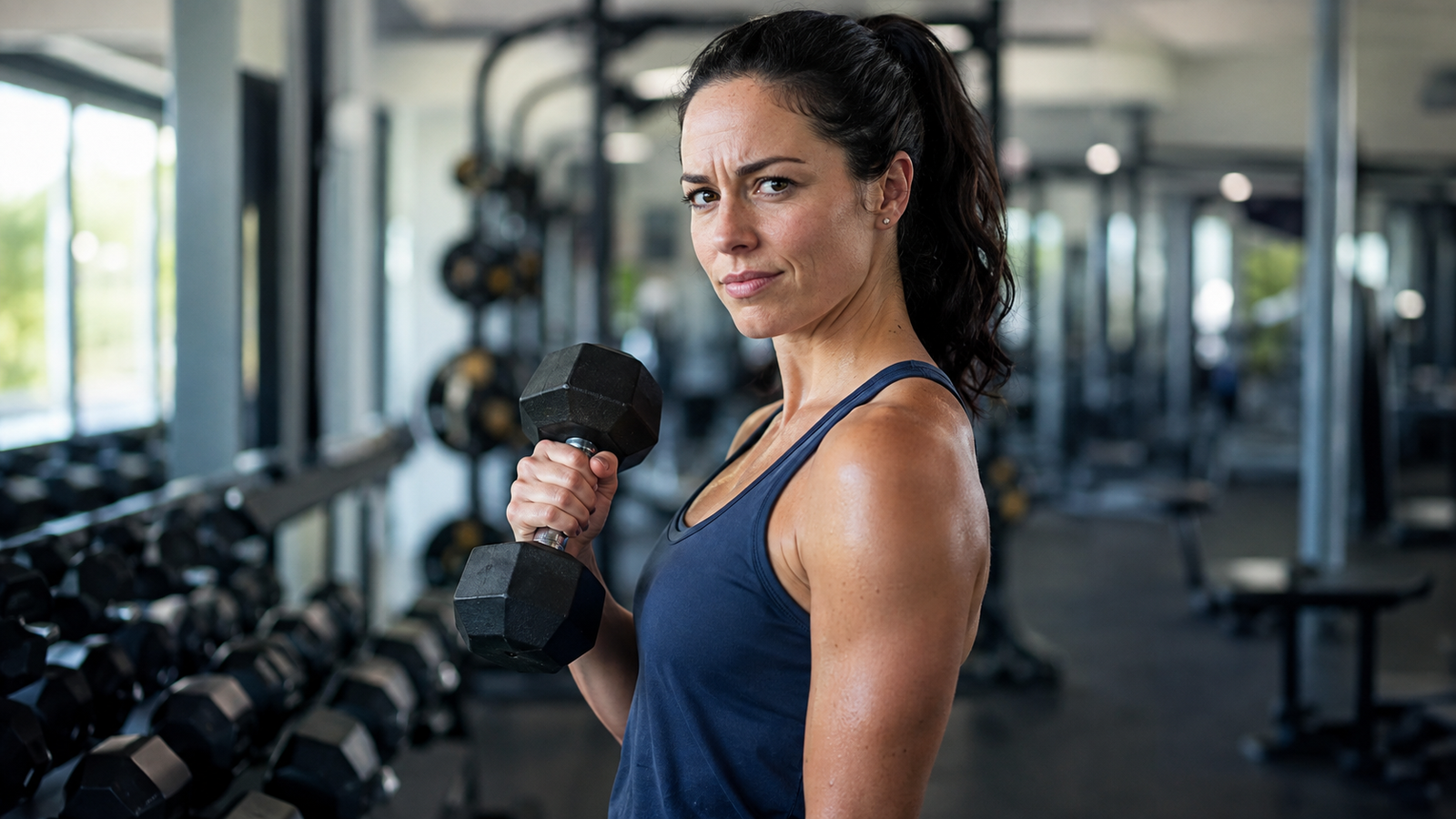
“Tone” is not a separate type of muscle. Women build strength and muscle through the same basic training principles—without needing to turn every session into high-rep punishment.
The word sounds scientific. It is mostly marketing.
“Tone your arms.” “Tone your legs.” “Long, lean muscle.”
Fitness marketing has spent decades giving women a separate vocabulary for resistance training, as if the goal requires a different kind of muscle.
Muscle does not become a special “toned” tissue because the dumbbell is lighter or the repetitions are higher. The appearance people call toned usually reflects some combination of muscle development, body-fat level, genetics and where fat is distributed.
If you want more visible shape, building muscle is part of the equation.
Women respond strongly to resistance training
Systematic reviews show that healthy adult women can make large improvements in muscular strength and hypertrophy with resistance training.
Research comparing men and women also suggests that relative adaptations to training are more similar than many stereotypes imply. Men tend to start with greater absolute muscle mass and strength, but women are not physiologically limited to tiny weights and endless repetitions.
The programming should match the individual’s goal, experience and preferences—not a gendered color palette.
Heavier does not mean “maximum weight every session”
Rejecting the toning myth does not mean every woman needs to train like a competitive powerlifter.
“Heavier” simply means using loads that are meaningfully challenging for the rep range. The 2026 ACSM position stand notes that strength is optimized with heavier loading, while muscle growth can occur across a range of resistance-training methods when enough effective work is performed.
A set of eight challenging goblet squats can be useful. So can a set of fifteen leg presses. What matters is that the resistance is hard enough to create adaptation and that the program progresses over time.
High reps are not bad—they are just not uniquely feminine
Sets of 15 to 20 repetitions can build muscle when performed with appropriate effort. They can also be exhausting.
The problem is not high-rep training itself. The problem is prescribing only light, high-rep work to women because of the fear that heavier lifting will suddenly make them “bulky.”
Building large amounts of muscle takes time, consistent training, adequate nutrition and genetics. It does not happen accidentally after a month of progressively heavier rows and squats.
A good beginner program is refreshingly ordinary
A woman beginning resistance training does not need a complicated “female metabolic” split.
A strong starting program can include:
- a squat or leg-press pattern;
- a hip hinge such as a Romanian deadlift;
- a horizontal press;
- a row;
- a vertical pull or assisted pulldown;
- a lunge or split squat;
- optional direct arm, shoulder, calf and core work.
Train major muscle groups at least twice per week, use loads you can control, and gradually increase the challenge.
That is not glamorous. It is effective.
What about fat loss?
Resistance training does not spot-reduce fat from the area being trained. Triceps exercises can strengthen and grow the triceps, but they cannot instruct the body to remove fat specifically from the back of the arm.
If a leaner appearance is the goal, overall energy balance matters. Resistance training helps preserve or build muscle while nutrition drives most of the calorie deficit.
That is why the best “toning” plan is usually not a special workout at all. It is resistance training plus an appropriate nutrition strategy.
The confidence benefit is not just aesthetic
Strength changes how ordinary life feels.
Carrying groceries becomes easier. Luggage is less intimidating. A push-up you could not perform becomes possible. Loads that once felt heavy become warm-ups.
These outcomes matter even if the scale barely moves.
A fitness program built entirely around looking smaller can miss the psychological value of becoming more capable.
The VELOFITZONE takeaway
Women do not need a separate low-weight physiology to become leaner, stronger or more defined.
Train the major muscle groups, use challenging loads across sensible rep ranges, progress gradually and eat according to the goal. If you enjoy high-rep circuits, use them. If you enjoy heavier squats and rows, use those too.
“Toning” becomes much less mysterious when you call the process what it is: build muscle, manage body fat, and get stronger.
Explore more routines in the Women’s Workouts cluster, including How to Start Pilates at Home, and pair training with the Calorie Calculator.
References
- Hagstrom AD, et al. The Effect of Resistance Training in Women on Dynamic Strength and Muscular Hypertrophy: A Systematic Review and Meta-analysis.
- Roberts BM, et al. Sex Differences in Resistance Training: A Systematic Review and Meta-Analysis.
- American College of Sports Medicine. 2026 Resistance Training Guidelines Update.
- Lopez P, et al. Resistance Training Load Effects on Muscle Hypertrophy and Strength Gain: Systematic Review and Network Meta-analysis.