Men's Workouts
What Is the Best Arm and Upper-Body Workout for Beginner Men?
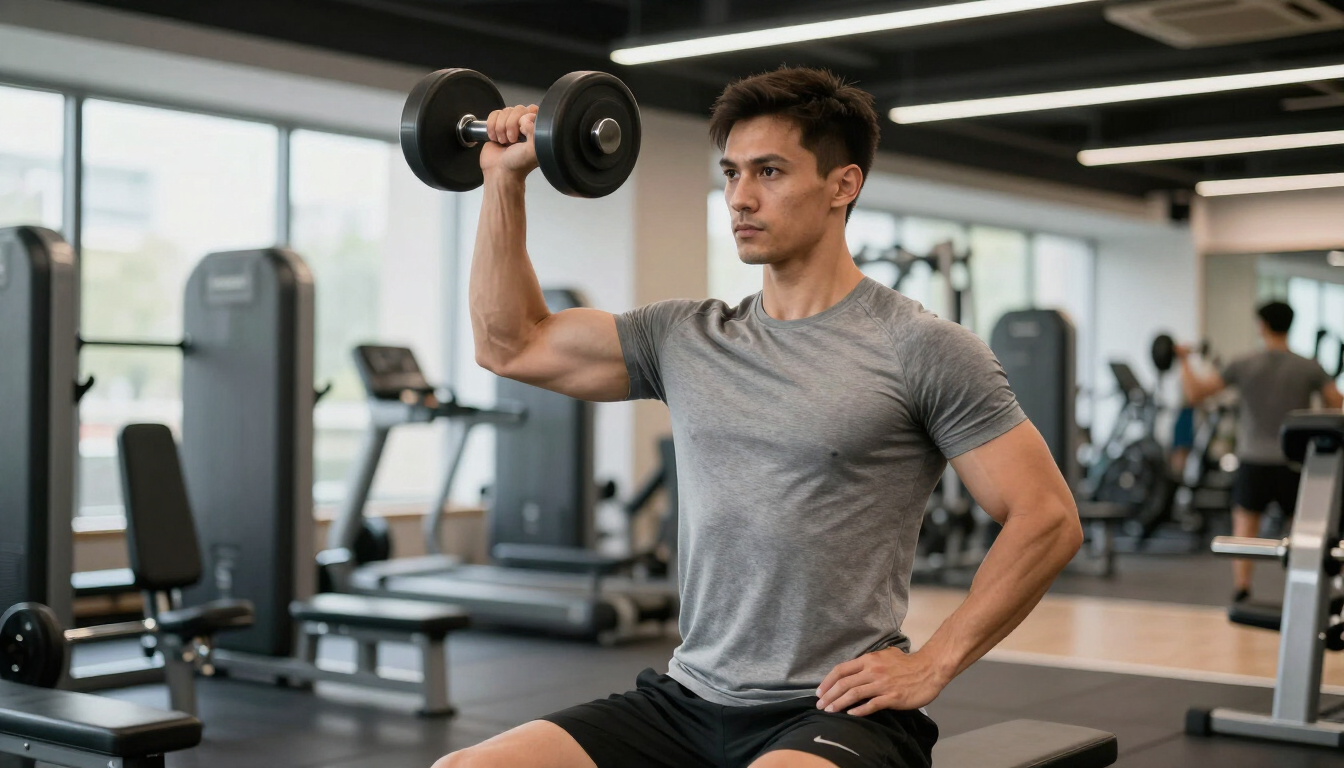
If your goal is bigger or stronger arms, the obvious temptation is to build the whole workout around curls. That is incomplete. Your biceps and triceps matter, but they work inside a larger upper-body system. Pulling exercises train the back and biceps together; pressing exercises train the chest, shoulders and triceps together; direct arm work then adds targeted volume.
A better beginner plan therefore has three layers: a push, a pull, and direct arm work. That structure builds the surrounding upper body while still giving the arms enough attention to progress.
The short answer
Use 5-6 exercises, keep most sets around 8-15 controlled reps, rest long enough to repeat good technique, and train the upper body at least twice per week if your schedule and recovery allow. Do not judge the workout by how swollen your arms feel afterward.
The paid 28-day plan expands this free sample into a structured four-week progression.
Why arms-only training leaves progress on the table
| Movement | Main muscles | Why it belongs |
|---|---|---|
| Vertical pull | Lats, upper back, biceps | Builds pulling strength and gives the biceps meaningful compound work. |
| Horizontal pull | Upper back, rear delts, biceps | Balances pressing and trains scapular movement. |
| Chest press | Chest, triceps, front delts | A strong base for upper-body pushing. |
| Shoulder press | Delts, triceps | Builds overhead strength and shoulder musculature. |
| Curl | Biceps, brachialis, forearms | Adds direct elbow-flexor work. |
| Triceps pressdown | Triceps | Adds direct elbow-extension work. |
This does not mean every workout needs six different exercises forever. It means your training should not neglect the large muscle groups that create most of the upper-body structure.
Want the complete 28-day upper-body progression? The free session gives you the framework — the paid plan organizes three repeatable workouts across four progressive weeks. View the 28-Day Strong Arms & Upper Body Plan →
The beginner upper-body workout
| Exercise | Sets x reps | Rest | Key cue |
|---|---|---|---|
| Lat pulldown | 2-3 x 8-12 | 75-120 sec | Pull toward upper chest; elbows down. |
| Machine or dumbbell chest press | 2-3 x 8-12 | 75-120 sec | Keep shoulders controlled; do not bounce. |
| Seated cable row | 2 x 8-12 | 60-90 sec | Pull to lower ribs without rocking. |
| Dumbbell shoulder press | 2 x 8-12 | 60-90 sec | Keep ribs stacked; press smoothly. |
| Dumbbell or cable curl | 2 x 10-15 | 45-75 sec | Keep upper arm quiet; control the lowering. |
| Rope triceps pressdown | 2 x 10-15 | 45-75 sec | Elbows stay near the torso; finish without swinging. |
If you have never lifted before, start with two sets for most exercises. The goal is not to copy the weekly volume of someone who has trained for five years. Your first job is to tolerate training, learn the movements and create room for future progression.
How close to failure should you train?
Use a “reps in reserve” approach. If you finish a set and believe you could have completed three more clean reps, you had roughly three reps in reserve. For most beginner work, finishing with about two to four good reps left is a sensible starting point. You can train harder later, but you do not need to make every set a test of willpower.
The 2026 ACSM position stand, based on an umbrella review spanning more than 137 reviews and data from over 30,000 participants, emphasizes progressive resistance training while noting that momentary muscular failure is not necessary for the average healthy adult. That is particularly useful for beginners who are still learning technique.
How much weekly volume do you need?
For muscle growth, the new ACSM guidance notes that higher weekly volume - around 10 sets per muscle group - can optimize hypertrophy. That number should not be treated as a mandatory beginner minimum. If you are new, fewer high-quality sets can produce progress because almost any consistent resistance training is a large increase from zero.
Beginner interpretation
- Do not jump immediately to 10 hard sets for biceps, 10 for triceps, 10 for chest and 10 for back. Start with the sample volume, repeat it consistently, recover well, and add work only when performance is stable.
Want the complete 28-day upper-body progression?
The free session gives you the framework. The paid plan organizes three repeatable workouts across four progressive weeks, with a full exercise library, logs, recovery and Month-2 progression.
View the 28-Day Strong Arms & Upper Body PlanThe simplest progressive-overload system
- Choose a repetition range, such as 8-12.
- Use a weight that allows clean reps with a few reps in reserve.
- Keep the same weight until you can reach the top of the range across your sets.
- Increase the load by the smallest practical amount.
- Return to the lower end of the range and build again.
For example, you might press 25-lb dumbbells for 10, 9 reps. Over several sessions you build to 12, 12. At that point, a small load increase is justified. That is progressive overload without constantly changing exercises.
Why rest periods matter
Short rest can make a workout feel harder, but feeling harder is not always better for strength or muscle. If your next set drops from 12 clean reps to 5 because you rested only 20 seconds, fatigue - not the target muscles - is deciding the session. For compound upper-body exercises, 75-120 seconds is a practical beginner range; take longer if needed. Isolation exercises can often use somewhat shorter rests.
CDC/NCHS 2020 data: the percentage of U.S. men meeting both aerobic and muscle-strengthening guidelines declined substantially with age.
Strength training is only one part of the fitness picture
In 2020, 28.3% of U.S. men met both aerobic and muscle-strengthening guidelines. Among men age 18-34 the figure was 41.3%, declining to 15.3% among men age 65 and older. An arm program is useful, but it should not crowd out lower-body training, aerobic activity, sleep and general movement.
The public-health target for adults remains at least 150-300 minutes of moderate aerobic activity per week plus muscle-strengthening work for the major muscle groups on at least two days. Your upper-body plan should fit inside that bigger picture.
Common mistakes that stall beginner arm growth
| Mistake | Better approach |
|---|---|
| Changing exercises every session | Keep key movements long enough to measure progress. |
| Using momentum on curls | Lower the load and keep the upper arm controlled. |
| Skipping back work | Use both vertical and horizontal pulling. |
| Training every set to failure | Leave reps in reserve on most beginner sets. |
| Adding volume faster than you can recover | Add sets only when performance and joints remain stable. |
| Ignoring calories, protein and sleep | Training is the stimulus; recovery helps you adapt. |
Frequently asked questions
Frequently Asked Questions
Explore more men's workout guides from VELOFITZONE.
Get the Complete 28-Day Strong Arms & Upper Body Plan
Stop guessing what to do next. The complete guide includes the 28-day calendar, three structured upper-body workouts, full biceps/triceps/shoulder/chest/back programming, substitutions, nutrition and recovery guidance, workout logs and Day-28 retesting.
Get the Complete 28-Day Strong Arms & Upper Body PlanReferences
- CDC/NCHS. Physical Activity Among Adults Aged 18 and Over: United States, 2020. Data Brief No. 443. https://www.cdc.gov/nchs/products/databriefs/db443.htm
- American College of Sports Medicine. 2026 resistance training position stand / guidance. https://acsm.org/resistance-training-guidelines-update-2026/
- Currier BS, et al. Resistance Training Prescription for Muscle Function, Hypertrophy, and Physical Performance in Healthy Adults. 2026. PMID: 41843416. https://pubmed.ncbi.nlm.nih.gov/41843416/
- U.S. Department of Health and Human Services. Physical Activity Guidelines for Americans, 2nd edition. https://odphp.health.gov/our-work/nutrition-physical-activity/physical-activity-guidelines/current-guidelines/top-10-things-know